
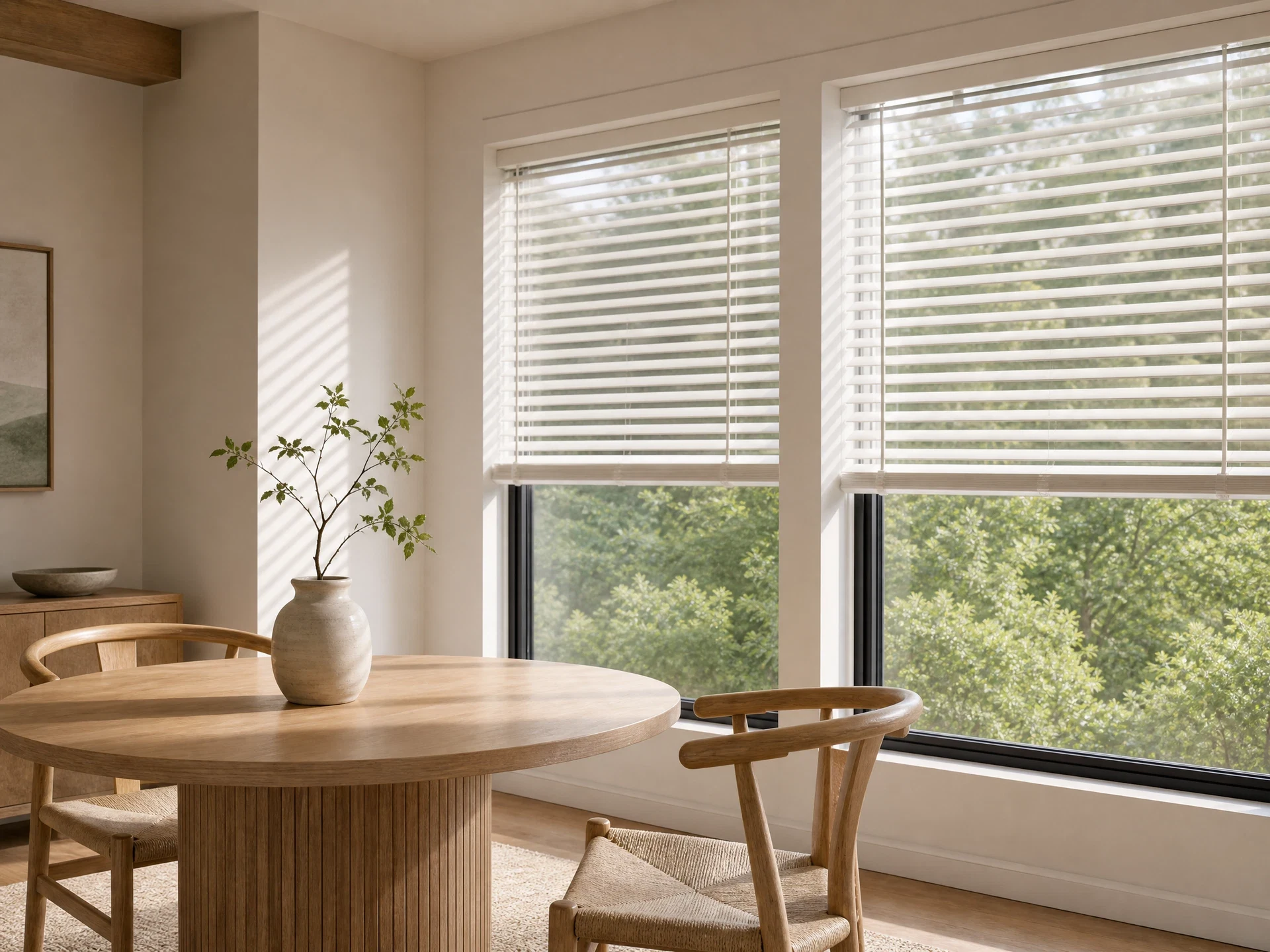
2.5-inch slats put about seven fewer slats across a typical window and stack tighter — but often mean a premium line. How to choose a slat width.
Short answer
A 2.5-inch slat is 25% wider, which puts roughly seven fewer slats across a 60-inch window and stacks about 20% tighter when raised. Choose 2 inches for narrow and standard windows, and 2.5 inches for large windows where proportion and view matter — but check whether the higher price is the slat width or a jump into a premium product line.
What to compare for Two-Inch vs. Two-and-a-Half-Inch Blinds
Use these product-specific prompts to keep the decision tied to the window, the room and the daily pattern around it.
Window scale
Under about 24 inches wide, a 2.5-inch slat leaves so few slats that the blind reads heavy. Above about 60 inches, a 2-inch slat starts to look busy.
View-through
Fewer slats means fewer ladder cords crossing the glass. On a 60-inch-tall window that is roughly seven fewer lines through the view.
What you are actually paying for
Many manufacturers only offer 2.5-inch slats in their upper lines, so the price jump is often the line change, not the extra half inch.
What actually changes between 2″ and 2.5″
A 2.5-inch slat is 25% wider than a 2-inch slat. That single change produces four downstream effects, and only one of them is about looks.
| 2″ slats | 2.5″ slats | |
|---|---|---|
| Slat spacing | about 1.75″ | about 2.25″ |
| Slats across the window | roughly 34 | roughly 27 |
| Stack when fully raised | taller | roughly 20% tighter |
| Typical availability | every line | often upper lines only |
Seven fewer slats is seven fewer ladder cords running down the glass. That is the difference people actually notice from across the room, more than the width of any single slat.
Why 2.5″ often costs noticeably more
This is where the online advice usually goes wrong. The extra half inch of material costs very little. The price difference appears because a lot of manufacturers only offer 2.5-inch slats in their premium lines — so choosing the wider slat quietly moves you into a different product tier with different valances, finishes and warranties.
It is worth asking the question directly before you decide: is this quote higher because of the slat width, or because the 2.5-inch option only exists in a higher line? If it is the line, compare what else changed. Sometimes the upgrade is worth it on its own merits and the slat width is incidental.
Which window gets which slat
Slat width is a proportion decision, and proportion depends on the opening.
- Narrow windows, under roughly 24″ wide. Stay with 2″. A 2.5″ slat leaves so few slats in the opening that the blind looks top-heavy and adjusts coarsely.
- Standard double-hungs. Either works. 2″ is the default for a reason — it suits the scale of most bedroom and bath windows.
- Large windows, sliders and two-story spans. 2.5″ holds proportion where 2″ starts to read as visual noise, and the tighter stack matters more on tall glass.
- Very wide single blinds. Wider slats add weight. Past roughly 72″, ask about splitting the blind on a shared headrail or motorizing it rather than lifting it by hand every day.
Privacy, light and the trade-off nobody mentions
Fully closed, both sizes block similarly — slats overlap either way. The difference shows up at partial tilt, which is how most blinds actually live.
At any given tilt angle, a wider slat opens a wider gap. That gives you more view and more daylight in the same motion, and marginally less privacy. In a front-facing living room that trade lands differently than it does in a ground-floor bedroom, which is why the honest answer depends on the room rather than the slat.
A short way to decide
Hold a sample of each against the actual window, in daylight, and step back to where you normally sit. Slat width is a proportion question, and proportion cannot be judged from a photograph or a sample board on a table.
Then ask what the quote difference is really buying. If both sizes come from the same line, the choice is purely visual. If the wider slat means moving lines, you are making a bigger decision than half an inch.
Common questions
Are 2.5-inch blinds worth the extra cost?
On large windows, often yes — the proportion is better and the stack is tighter. On standard or narrow windows the visual gain is small. Check whether the price difference is the slat width itself or a jump into a higher product line, because that changes the answer.
Do wider slats block more light?
Fully closed, the two are very similar. At partial tilt a 2.5-inch slat opens a wider gap, so it lets in more daylight and gives more view in the same motion, with slightly less privacy.
Which slat size makes a window look bigger?
Wider slats generally do, because fewer horizontal lines cross the glass and less of the view is interrupted. The effect is most noticeable on tall windows.
What slat size is standard for faux wood blinds?
Two inches is the standard and the most widely available. Two-and-a-half inches is the upgrade option and is frequently limited to a manufacturer's premium lines.
Ready to compare the options in context?
Schedule an In-Home Consultation